
Java Data Structures in Hindi Free Course
Data Structure in Java in Hindi
 4.31
Beginner level
3.75 learning hrs
4.31
Beginner level
3.75 learning hrs
Learn key concepts like Array, LinkedList, Stack, and Queue via Java Data Structure Course in Hindi
Instructor:
Mr. Faizan Parvez




About this course
Data structure deals with structuring or organizing data in the computer system so that the data can be used in an effective manner. For example, linearly storing data - Array or Linked Lists, storing data one upon the other - Stack, Hierarchical manner - Trees, and Connecting Nodes - Graph. In this Data Structures in Java course in Hindi, you will learn and understand different data structures in Hindi, principles like Stack and Queue, and understand hierarchical data structures like Binary Tree, Binary Search Tree, and Graphs.
Great Learning provides you with several Post-Graduate, Advanced, and Degree Programs in the Software Development domain. Read more about the top-rated Online Software Development Courses in India and earn a post-graduate, advanced, or degree certificate in software development from well-established universities in India. Our university partners are IIT Madras, IIT Roorkee, IIIT Hyderabad, and JAIN (Deemed-to-be University). These software development courses will teach you everything you need to know about data structures and algorithms to successfully excel in your software development career.
Course outline
Introduction to Hive Hands-On
Hive is a data warehouse used to support interaction between the user and HDFS. This course will give you a demonstration using sample problem statements for your better understanding.
Linked List
A linked list is a linear type of data structure that comes in handy while solving complex problems. This module gives a brief on the linked list along with discussing its advantages, disadvantages, and applications. You also have a demonstration on a linked list with the help of a code example.
Stack
Stack comes under a linear data structure and is known for its FILO/LIFO property. The module focuses on introducing you to stack and goes through its several advantages, disadvantages, and applications. You will also learn about its demonstration using an array with the help of a code example.
Queue
A queue is a linear form of data structure and follows the FIFO/LILO property. The module starts by giving you a brief on queue, its advantages, disadvantages, and applications. Lastly, you will have a demonstration of the queue using an array with the help of a code example.
Summary
This comprehensive module on Organizational Behaviour, covers the concept, importance, elements, levels, types, and objectives of the field. It provides a deep understanding of the subject to enhance interpersonal and communication skills and create a positive work environment.
Get access to the complete curriculum once you enroll in the course
 4.31
4.31




Our course instructor

Mr. Faizan Parvez


Frequently Asked Questions
Will I receive a certificate upon completing this free course?
Is this course free?
Will I get a certificate after completing this Data Structure in Java Hindi free course?
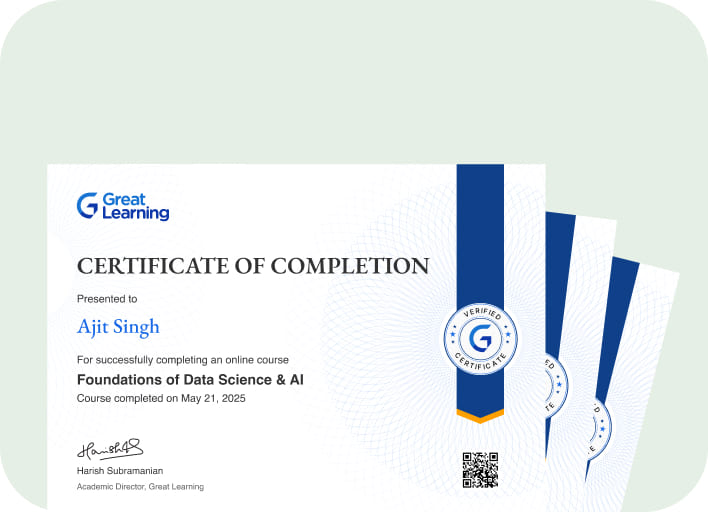
Yes, you will get a certificate of completion for Data Structure in Java Hindi after completing all the modules and cracking the assessment. The assessment tests your knowledge of the subject and badges your skills.
How much does this Data Structure in Java Hindi course cost?
It is an entirely free course from Great Learning Academy. Anyone interested in learning the basics of Data Structure in Java Hindi can get started with this course.
Is there any limit on how many times I can take this free course?
Once you enroll in the Data Structure in Java Hindi course, you have lifetime access to it. So, you can log in anytime and learn it for free online.
Can I sign up for multiple courses from Great Learning Academy at the same time?
Yes, you can enroll in as many courses as you want from Great Learning Academy. There is no limit to the number of courses you can enroll in at once, but since the courses offered by Great Learning Academy are free, we suggest you learn one by one to get the best out of the subject.
Why choose Great Learning Academy for this free Data Structure in Java Hindi course?
Great Learning Academy provides this Data Structure in Java Hindi course for free online. The course is self-paced and helps you understand various topics that fall under the subject with solved problems and demonstrated examples. The course is carefully designed, keeping in mind to cater to both beginners and professionals, and is delivered by subject experts. Great Learning is a global ed-tech platform dedicated to developing competent professionals. Great Learning Academy is an initiative by Great Learning that offers in-demand free online courses to help people advance in their jobs. More than 5 million learners from 140 countries have benefited from Great Learning Academy's free online courses with certificates. It is a one-stop place for all of a learner's goals.
What are the steps to enroll in this Data Structure in Java Hindi course?
Enrolling in any of the Great Learning Academy’s courses is just one step process. Sign-up for the course, you are interested in learning through your E-mail ID and start learning them for free online.
Will I have lifetime access to this free Data Structure in Java Hindi course?
Yes, once you enroll in the course, you will have lifetime access, where you can log in and learn whenever you want to.
What are data structures in Java?
A data structure is a mechanism for storing data, keeping it structured, and allowing for simple adjustment and access. Simply put, a data structure is a set of data values, their relationships, and the operations or functions that may be performed on them.
Data systems are made up of linked data and processes that can be performed on them. You'll learn about data structures all the time, whether you're new to computer programming or have been doing it for a long time. If you wish to become a decent programmer or simply have a programme that can perform simple operations, you must first understand data structures.
Programmes = Algorithms + data structures.
There is a great deal to learn about data systems. You'll want to understand what they are, why they're important, and which ones are the most important. This knowledge will benefit you if you're concerned about interview questions or just want to lay a strong basis for the rest of your coding education. The bottom line is that if you want to be a good programmer, you must first learn how to program Data Structures. In this course, you will learn, how to program all data structures in Java.
What are the types of data structures?
Depending on the form of data and what you want to do about it, data must be structured in a variety of ways. You must consider the various types of data structures and how they function in order to efficiently manage data and construct a programme. Data structures are often divided into linear and non-linear data structures in a general context. The following are some of the most popular data structures.
Linear Data Structures
- Arrays
- Stacks
- Queues
- Linked Lists
- Hash Tables
Non-Linear data structures
- Trees
- Graphs
- Tries
Which data structure is best for Java?
Don't equate the data structure to the programming language you're using, such as java or Python.
There are several ways for storing data in a data system... that each has advantages and disadvantages, so you must evaluate and consider the time complexity and auxiliary space before making a decision based on the problem.
The fastest is determined by the time complexity.
Any data structure has four operations. Create, read, edit, and erase are all options.
Each data structure can succeed at some operations while failing at others.
O(1) is the quickest in the graph.
Don't equate the data structure to the programming language you're using, such as java or Python.
There are several ways for storing data in a data system... that each has advantages and disadvantages, so you must evaluate and consider the time complexity and auxiliary space before making a decision based on the problem.
The fastest is determined by the time complexity.
Any data structure has four operations. Create, read, edit, and erase are all options.
Each data structure can succeed at some operations while failing at others.
O(1) is the quickest in the graph.
Is Java good for data structure?
It is preferable to study data structures in Java. The explanation is that... Java is a slow language. As a result, you'll attempt to improve the data structure in order to improve efficiency, and you'll learn more. The second thing to do is to continue to use courses to enforce them. Your morale will rise as a result of getting some professional taste.
And also, java has tons of build-in methods that simulate the logic of various operations on the data structure. Therefore, it is beginner-friendly to learn data structures in Java.
What is data structure and algorithm?
Data Structure
The data structure is a method of storing and organizing data in such a manner that we can effectively execute operations on it. Data Structures are used to organize and store data by making data components in terms of some relationship. For eg, we have information about a player named "Virat" who is 26 years old. The data types "Virat" and "26" are also String data types.
We will organize this information into a record called Match, which will include both the player's name and age. As a data system, we can now compile and archive player information in a file or folder. For instance, "Dhoni" is 30, "Gambhir" is 31, and "Sehwag" is 33.
Data Structures, in basic terms, are structures that are designed to contain structured data such that different operations can be done on it quickly. It reflects the data information that needs to be stored in memory. It should be planned and applied in a way that minimizes complexity while increasing performance.
Algorithm
An algorithm is a finite set of instructions or logic that must be written in a certain order to complete a predefined assignment. An algorithm is not a complete program or code; rather, it is the central logic (solution) of a query, which can be represented in a flowchart or as a high-level definition in pseudocode.
The following properties must be met for any algorithm:
External Inputs- The algorithm can have 0 or more external inputs.
Output - At the very least, one output should be achieved.
Definiteness- Each step of the algorithm should be clearly described and simple.
Finiteness- A finite number of steps should be present in the algorithm.
Correctness- Each step of the algorithm must produce a valid result.
How is data structure used in real life?
- You need to store interpersonal organization "takes care of". You don't have the foggiest idea about the size, and things may be powerfully added. - connected rundown or Hash table
- You need to store fix/re-try activities in a word processor. – stack (utilize 2 stacks for including re-try activity)
- You need to assess an articulation (i.e., parse). – stack or tree
- You need to store the fellowship data on an informal communication site. I.e., who is companions with who – chart
- You need to store a picture (1000 by 1000 pixels) as a bitmap. – ArrayList(java) or 2D cluster
- To carry out printer spoilers so that positions can be imprinted in the request for their appearance. – Stack
- To execute back usefulness in the web program. – Stack
- To store the potential moves in a chess game. – Tree
- To store a bunch of fixed watchwords which are referred to every now and again. – dynamic programming or hash table
- To store the client request data in a drive-in burger place. (Clients continue coming and they need to get their right foot at the installment/food assortment window.) – line/min Need Queue(if the request is basic and takes less time)
- To store the family history data of natural species. – Tree
What are the most important data structures?
The importance of various data structures varies from application to application. But to be specific the following data structure must be known by each programmer.
1. Tree
Because trees are used in :
- Folders in the Operating system:
- in windows go to the command line and type tree.
- HTML Document Object Model (DOM):
- Network Routing
- Syntax Tree in Compiler
- Autocorrect and spell checker
- Next Move in games
- In an Artificial intelligence game (opponent is CPU), the next moves are stored using a tree data structure
-
Linked List
Because Linked List is used in :
- Picture viewer – Prior and next photos are connected, so the next and previous buttons can be used to access them.
- Previous and next page in a web browser – Since they are interconnected as a linked list, we can view previous and next urls searched in a web browser by clicking the back and next buttons.
- Music Player – The previous and next songs in the music player are related. You may perform songs from the beginning or the end.
-
Array
Because Arrays are used in :
- Creation of Stack
- Creation of Queue
- Creation of Hashtable
-
HashMap
- Message Digest. A message digest is a cryptographic hash function containing a string of digits created by a one-way hashing formula.
- File System.
- Password Verification
- Pattern Matching.
- Programming Language.
- Compilers.
- Suggested Problems to solve in Hashing.
-
Heap
Heap is a way of optimization of complex algorithms that depend on finding the greatest to the smallest values in the Heap.
- HeapSort
- Graph Algorithm:- Dijkstra’s Algorithm
- Priority Queue and many more
Become a Skilled Professional with Pro Courses
Gain work-ready skills with guided projects, top faculty and AI tools, all at an affordable price.
 PRO
PRO








 (1).jpg)
.jpg)





 (1).png)







.png)

.png)

.png)
.png)
.png)
.png)
.png)
.png)
.png)


.png)
.png)
.png)




.png)



.png)
.png)
.png)


.jpg)
.png)
.png)

.png)
.jpg)

.jpg)
.jpg)
.jpeg)
.png)
.jpg)
.jpg)
.png)



Recommended Free Hindi courses
 FREE
FREE
 FREE
FREE
 FREE
FREE
 FREE
FREE
