
Earn a certificate & get recognized
Basics of Insurance
 4.6
Beginner level
2.25 learning hrs
4.6
Beginner level
2.25 learning hrs
Enrol for this free course on the Fundamentals of Insurance to gain insights into the world of insurance. Benefit from the expertise of our instructors and expand your understanding. Begin your learning journey today!
Instructor:
E Balachandra Murthy




About this course
The "Basics of Insurance" is a comprehensive and free course designed to provide a solid understanding of the insurance industry. Whether you're a newcomer or simply seeking to refresh your knowledge, this course covers essential topics in a concise manner.
The course begins with an "Introduction to Insurance," explaining the core concepts and the vital role insurance plays in our lives. Next, it delves into "Types of Insurance," exploring the various categories such as life, health, property, and liability insurance, providing insights into their specific functions. Understanding "Risk and Risk Management" is crucial in insurance. This section outlines how insurers assess and mitigate risks, ensuring financial stability.
Lastly, the "Insurance Claim Process" module walks you through the steps involved in filing and processing an insurance claim. This practical knowledge is invaluable when navigating insurance scenarios. By the end of this course, you'll have a solid foundation in insurance fundamentals, enabling you to make informed decisions, manage risks effectively, and confidently engage with insurance providers. Join us today to empower yourself with essential insurance knowledge.
Course outline
Intro to Insurance
This module provides insights into insurance's meaning, defining terms such as Policy, Premium, Coverage, Beneficiary, etc.
Types of Insurance
In this module, you will explore diverse insurance types, such as Health, Life, Auto, Marine, Property, and Home insurance.
Risk and Risk Management
In this module, you will discover key topics including risk overview, management, objectives, diverse risk types, and their connection to insurance.
Insurance Claim Process
This module focuses on insurance claims, such as notifying insurers, claim ID, damage details, documents, evaluation, inspection, and more.
Get access to the complete curriculum once you enroll in the course
 4.6
4.6







 India
India

 United States
 India
India
 Ireland
 United States
 India
India
 United States
Our course instructor

E Balachandra Murthy
Research Analyst
Management Expert


Frequently Asked Questions
Will I receive a certificate upon completing this free course?
Is this course free?
What are the prerequisites required to learn this Free Basics of Insurance Course?
You do not need any prior knowledge to learn this Basics of Insurance Course.
How long does it take to complete this Free Basics of Insurance Course?
Free Basics of Insurance Course is a 1.5 hour long course, but it is self-paced. Once you enrol, you can take your own time to complete the course.
Will I have lifetime access to the free course?
Yes, once you enrol in the course, you will have lifetime access to any of the Great Learning Academy’s free courses. You can log in and learn whenever you want to.
Will I get a certificate after completing this Free Basics of Insurance Course?
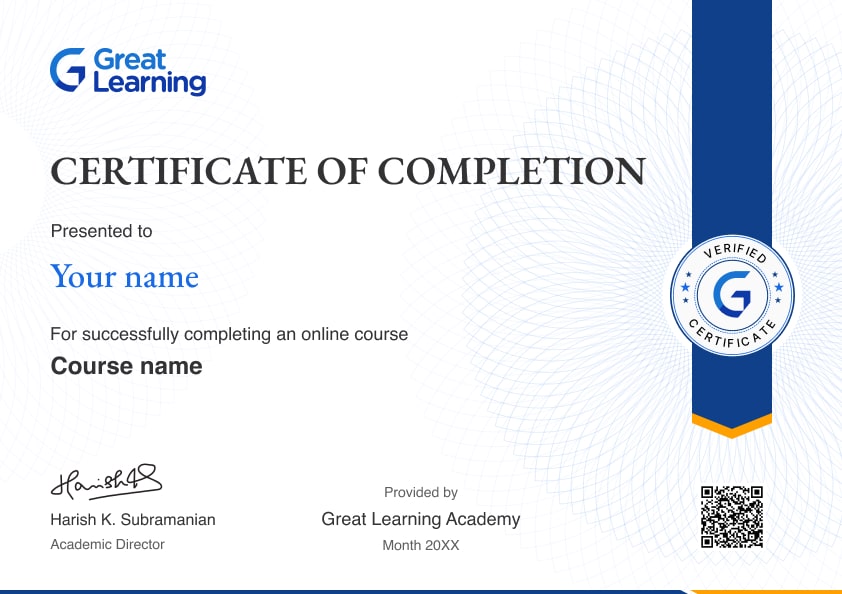
Yes, you will get a certificate of completion after completing all the modules and cracking the assessment.
How much does this Basics of Insurance Course cost?
It is an entirely free course from Great Learning Academy.
Is there any limit on how many times I can take this free course?
No. There is no limit. Once you enrol in the Free Basics of Insurance Course, you have lifetime access to it. So, you can log in anytime and learn it for free online.
Who is eligible to take this Free Basics of Insurance Course?
You do not need any prerequisites to learn the course, so enrol today and learn it for free online.
Become a Skilled Professional with Pro Courses
Gain work-ready skills with guided projects, top faculty and AI tools, all at an affordable price.
 PRO
PRO








 (1).jpg)
.jpg)




.png)

.jpg)

.jpg)


.jpeg)






.png)

.png)
.png)
.png)
.png)
.png)

.png)
.png)
.jpg)





.png)
.jpg)
.jpg)



.png)

.jpg)
.png)
.png)
.png)
.png)
.png)

.png)





 (1).png)

.png)

.png)
.png)


Recommended Free Management courses
 FREE
FREE
 FREE
FREE
 FREE
FREE
 FREE
FREE

Similar courses you might like
FREE
 FREE
FREE
 FREE
FREE
 FREE
FREE

Related Management Courses

-
Sponsored

Great Lakes Institute of Management
Post Graduate Diploma in Management (Online)24 Months · Online
Online MBA EquivalentKnow More
-
Walsh College
Doctor of Business Administration in General Management3 Years · Online
Top 10 best online DBA DegreeKnow More
-
Great Lakes Executive Learning
Executive PG Program in Management12 months · Online
Certificate from Great LakesKnow More






Relevant Career Paths >



Basics of Insurance
Insurance plays a vital role in modern society by providing individuals, businesses, and organizations with financial protection against unforeseen events and risks. It functions as a mechanism to mitigate the impact of potential losses, offering peace of mind and stability in an otherwise uncertain world. The concept of insurance revolves around the pooling of risks, where a large number of policyholders contribute premiums to create a fund that can be used to compensate those who experience losses.
The fundamental principle behind insurance is the transfer of risk from an individual or entity to an insurance company. This transfer is based on the principle of shared responsibility, where policyholders collectively cover the costs incurred by a few who face unexpected events. Insurance policies come in various forms, covering a wide range of risks, including life, health, property, liability, and even unique risks specific to certain industries or professions.
Life insurance is designed to provide financial support to beneficiaries in the event of the policyholder's death. It helps families and loved ones cope with the loss of income and financial stability, often serving as a critical safety net during difficult times. Health insurance, on the other hand, assists in covering medical expenses, ensuring that individuals can access necessary healthcare without facing exorbitant costs.
Property insurance safeguards physical assets such as homes, automobiles, and businesses against damage or loss due to events like fire, theft, or natural disasters. This type of insurance is particularly important for homeowners and business owners, as it enables them to recover and rebuild after unexpected incidents.
Liability insurance protects individuals and organizations from legal claims and financial obligations resulting from accidents, injuries, or damages they may cause to others. This is essential for businesses to manage potential legal liabilities that could arise in their operations.
Insurance operates on the concept of risk assessment and underwriting. Insurance companies analyze various factors to determine the level of risk associated with a policyholder or situation. These factors can include age, health status, driving record, location, and more. The risk assessment helps insurers set premium rates that reflect the likelihood of a claim occurring. Policyholders with higher risk profiles typically pay higher premiums, while those with lower risks pay lower premiums.
In the event of a covered loss, policyholders can file claims with their insurance company to receive compensation or reimbursement for the incurred expenses. Insurance companies then assess the claim, verifying its legitimacy and evaluating the extent of the loss. Once validated, the insurer provides the necessary funds to help the policyholder recover from the setback.
While insurance offers numerous benefits, it is not without challenges. One issue is the potential for moral hazard, where individuals or entities may take on riskier behavior because they feel protected by insurance. This can lead to increased claims and higher costs for insurers. Additionally, insurance fraud poses a significant challenge, as some individuals may attempt to deceive insurers for financial gain.
In conclusion, insurance is a crucial component of modern financial planning and risk management. It provides individuals and businesses with the security and support they need to navigate life's uncertainties. From safeguarding assets to protecting against legal liabilities and offering financial support during tough times, insurance plays a pivotal role in promoting stability and resilience across various aspects of society. As the landscape of risks continues to evolve, the insurance industry adapts and innovates to meet the ever-changing needs of individuals and organizations alike.