Free C programming Course
C for Beginners
 4.49
Beginner level
3.0 learning hrs
4.49
Beginner level
3.0 learning hrs
Learn variables, data types, operators, arrays, functions, and pointers with hands-on examples. Enroll in this free C Programming course to build a strong foundation in coding from scratch.
Instructor:
Mr. Bharani Akella




About this course
This C programming course will help you develop the practical skills needed to write efficient programs and solve real-world programming challenges. You’ll gain a solid understanding of C’s core concepts, enabling you to create system application software and work with complex data structures, preparing you for a variety of programming tasks in any development environment.
The course covers key topics such as variables, data types, and operators, helping you grasp how data is handled in C. You’ll also explore input and output statements, arrays, and functions, gaining practical experience in manipulating data and structuring programs. As you progress, you’ll learn about strings, structures, unions, and pointers, which are critical for working with complex data structures in C.
Course outline
C Program Structure: Preprocessor, Compilation (GCC), and Main Function
trace the C compilation pipeline: Preprocessor (#include), Compiler, Assembler, and Linker. Write the skeleton syntax including void main()and header files.
Variables & Identifiers: Declaration, Initialization, and Scope Rules
Define variables using specific naming conventions (Identifiers) and manage visibility via Local vs. Global scope. Assign values to memory locations using the assignment operator (=).
Primitive Data Types: int, float, char, and Size Modifiers
allocate memory using primitive types: int (Integers), float / double(Decimals), and char (Characters). Apply modifiers like signed, unsigned, short, and long to optimize storage.
I/O Operations: printf, scanf, and Format Specifiers (%d, %s)
Execute Input/Output using the
C Operators: Arithmetic, Relational, Bitwise, and Ternary
Perform calculations using Arithmetic(+, % Modulo), Relational (==, !=), and Logical (&&, `
Array Data Structures: Zero-Based Indexing and Memory Contiguity
Store collections of homogenous data in contiguous memory blocks. Access elements using Zero-Based Indexing(arr[0]) and iterate through 1D Arraysand 2D Matrices using loops.
Modular Programming: Function Prototypes, Parameters, and Return Types
Structure code using Function Declarations (Prototypes) and Definitions. Pass data via Argumentsand return values using the returnstatement. Differentiate between Voidand typed functions.
String Manipulation: Null Terminator () and <string.h>
Manage text as character arrays terminated by a Null Character (). Perform operations using the
User-Defined Types: structvs. unionMemory Allocation
Group related variables using Structures (struct) accessed via the Dot Operator (.). optimize memory with Unions, where all members share the same memory location (largest member size).
Pointer Mechanics: Address-of (&), Dereferencing (*), and Arithmetic
Access direct memory addresses using the Address-of Operator (&) and retrieve values using the Dereference Operator (*). Navigate arrays using Pointer Arithmetic (incrementing memory addresses).
Get access to the complete curriculum once you enroll in the course
 4.49
4.49
Level up with advanced skills & become job ready with Pro+
Subscribe to Pro+ today to build skills with 50+ Pro courses and prep for jobs with advanced AI tools.
 PRO
PRO

Practice exercises
Guided Projects
AI Resume Builder
AI mock interviews






 India
India

 Philippines
 India
India
 India
India
 India
India

 Thailand
 India
India
 India
India
 India
India
 India
India
Our course instructor

Mr. Bharani Akella
Data Scientist
IT & Software Expert


Frequently Asked Questions
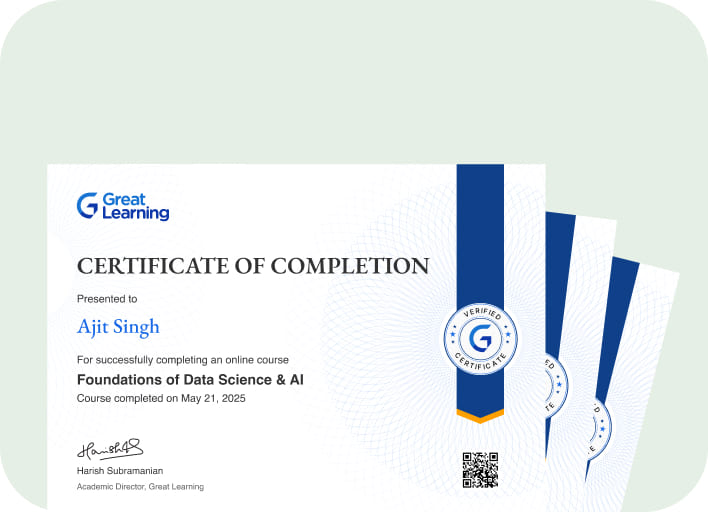
Will I receive a certificate upon completing this free course?
Is this course free?
What will I learn in this free C programming course?
You learn core C fundamentals starting from the basics. The course covers variables, data types, input and output statements, operators, arrays, functions, strings, structures and unions, and pointers. This free C programming course builds a strong base and helps you learn C for free with clear examples.
What is the duration of this C programming online course free?
This C programming online course is free and includes about 3.0 hours of learning content. The structure supports flexible study for learners who prefer a self-paced, free online C programming course.
Is this free C course suitable for beginners?
Yes, This free C course is designed for beginners with no prior coding background. The lessons start from scratch and gradually build core programming logic.
Can I learn C in a week?
You can grasp the basics in a week with intensive study, but mastering C requires more time to understand and apply its concepts effectively.
Is the C language basics Course a certification course?
Can I learn C in 3 months?
Yes, it's possible to achieve a good understanding of C and write basic programs within 3 months, especially with consistent practice and study.
What skills will I gain from this free online C programming course?
You will gain skills in:
- Variables in C
- Data Types
- I/O operations in C
- Operators
- Arrays
- Functions in C
- Strings
- Structure and Unions
- Pointers in C
Does this free C programming course include hands-on practice?
Yes, The course focuses on concept clarity through examples and practical explanations, helping reinforce your learning while you learn C for free
Is C language easy or hard?
The difficulty is subjective. C has a steep learning curve due to manual memory management and pointers, but it's also straightforward in terms of syntax and structure.
Who should enroll in this free online C programming course?
This course is suitable for students, beginners, and working professionals who want to start programming or refresh their fundamentals. It also works well before moving into advanced languages.
Is C the hardest programming language?
C is not necessarily the hardest; it depends on the learner's background. Some find low-level aspects of C challenging, while others may struggle more with languages that have complex syntax or abstract concepts.
How does this course help before taking a C++ course?
This free C programming course builds logic and core programming concepts. After completing it, learners transition more smoothly into a beginner C++ course.
Can I sign up for multiple courses from Great Learning Academy at the same time?
Yes, you can enroll in as many courses as you want from Great Learning Academy. There is no limit to the number of courses you can enroll in at once, but since the courses offered by Great Learning Academy are free, we suggest you learn one at a time to get the most out of the subject.
Is this free C programming course self-paced?
Yes, You start anytime and progress at your own speed. This makes it suitable for learners looking for a flexible free online C programming course experience.
How many times can I take this free course?
Once you enroll in the C for Beginners course, you have lifetime access to it. So, you can log in anytime and learn it for free online.
Can I sign up for multiple courses from Great Learning Academy at the same time?
Yes, you can enroll in as many courses as you want from Great Learning Academy. There is no limit to the number of courses you can enroll in at once, but since the courses offered by Great Learning Academy are free, we suggest you learn one by one to get the best out of the subject.
Is there any limit on how many times I can take this free course?
Once you enroll in the C for Beginners course, you have lifetime access to it. So, you can log in anytime and learn it for free online.
Become a Skilled Professional with Pro Courses
Gain work-ready skills with guided projects, top faculty and AI tools, all at an affordable price.






.jpg)

.png)
.png)
.png)


.png)
.jpg)

.jpg)
.png)
.jpg)
.jpeg)







.png)
.png)
.png)
.png)
.png)
.jpg)
.jpg)
.png)

.png)
.png)



 (1).png)

.jpg)
.png)
.png)
.png)
.png)

.png)

 (1).jpg)

.png)
.png)
.png)
.png)

.png)
.png)

.png)



Recommended Free C++ courses
 FREE
FREE
 FREE
FREE
 FREE
FREE
 FREE
FREE

Similar courses you might like
FREE
 FREE
FREE
FREE
FREE
 FREE
FREE