
Generative AI Free Course with Certificate
Generative AI for beginners
 4.53
Beginner level
3.0 learning hrs
4.53
Beginner level
3.0 learning hrs
Learn the fundamentals of AI, machine learning algorithms, neural networks, and deep learning techniques like CNNs and RNNs. Join this free Generative AI course and discover the impact of LLMs in real-world applications.




About this course
This free Generative AI course is designed to provide you with a comprehensive understanding of key Artificial Intelligence concepts. You’ll start by learning the fundamentals of AI, addressing its constraints and challenges. The course will cover essential Machine Learning algorithms and their practical applications. You’ll gain insight into Neural Networks and explore Deep Learning techniques such as Convolutional Neural Networks (CNNs) and Recurrent Neural Networks (RNNs). As we progress, you will also get an Introduction to AI Tools/Platforms, covering popular tools such as TensorFlow, PyTorch, and Hugging Face. This will help you gain a basic understanding of the tools commonly used in AI. The course will also emphasize the significance of Large Language Models (LLMs) and demonstrate how they are used across various industries. You’ll explore Generative Models in AI, understanding both their mathematical underpinnings and real-world applications. This free Generative AI course with a certificate offers a deep dive into the field, equipping you with the knowledge and skills to apply this cutting-edge technology effectively. By the end of the course, you will have a strong foundation in Generative AI, ready to tackle real-world challenges.
Course outline
Fundamentals of Artificial Intelligence (AI): Narrow vs. General AI
Define Artificial Intelligence (AI) and trace its historical milestones. Classify AI into Artificial Narrow Intelligence (ANI) and Artificial General Intelligence (AGI). Explore the role of AI in Natural Language Processing (NLP) and core ethical implications.
AI Limitations: Data Quality, Bias, and Human-in-the-Loop
Identify the constraints of Artificial Intelligence. Analyze the impact of data quality and algorithmic bias on model performance. Understand the necessity of Human-in-the-Loop (HITL) intervention and governance for responsible AI deployment.
Machine Learning (ML) Paradigms: Supervised, Unsupervised, and Reinforcement
Differentiate the three primary Machine Learning (ML) paradigms: Supervised Learning (labeled data), Unsupervised Learning (pattern discovery), and Reinforcement Learning (reward-based training).
Core ML Algorithms: Classification vs. Regression Models
Implement foundational Machine Learning algorithms. Distinguish between continuous predictive modeling using Regression algorithms (e.g., Linear Regression) and categorical sorting using Classification algorithms (e.g., Logistic Regression, Decision Trees).
Applied Machine Learning: Predictive Modeling and Autonomous Systems
Evaluate real-world applications of Machine Learning, including time-series forecasting and computer vision for autonomous vehicles (self-driving cars). Assess technical challenges such as model overfitting, underfitting, and computational scalability.
Artificial Neural Networks (ANN): Architecture and Applications
Construct the architecture of Artificial Neural Networks (ANN). Map nodes, hidden layers, and activation functions. Explore practical applications of neural networks in pattern recognition and predictive analytics.
Brief of Deep Learning, CNN, and RNN Concepts
In this module, you will get an overview of the concept of deep learning, discussing its advantages and challenges. You will also learn the concepts of CNN (Convolutional Neural Networks) and RNN (Recurrent Neural Networks).
Deep Learning Principles: Feature Extraction and Layered Representations
Analyze the fundamental principles of Deep Learning architectures. Contrast Deep Learning with traditional Machine Learning, focusing on automatic feature extraction, layered representation learning, and the computational capacity to handle unstructured data.
Large Language Models (LLMs) and Transformer Architecture
Trace the evolution of Large Language Models (LLMs). Deconstruct the Transformer architecture, focusing on the self-attention mechanism that enables foundational models to process complex contextual relationships in natural language effectively.
Generative AI Frameworks: Generative vs. Discriminative Models
Define Generative AI concepts and data generation capabilities. Compare Generative Models (which learn joint probability distributions to synthesize new, original data) against Discriminative Models (which learn conditional probability boundaries for data classification).
Advanced Generative Architectures: GANs and VAEs
Deploy state-of-the-art Generative AI frameworks. Understand the adversarial training mechanism of Generative Adversarial Networks (GANs) and the probabilistic latent space mapping of Variational Autoencoders (VAEs) for high-fidelity image and text synthesis.
Mathematical Foundations of AI: Probability, Statistics, and Sampling
Apply the mathematical prerequisites for AI engineering. Utilize Probability theory, Statistical distributions, and advanced sampling methods (such as Monte Carlo sampling) to optimize machine learning algorithms and stabilize generative model training.
Responsible AI: Ethics, Fairness, and Algorithmic Transparency
Implement frameworks for Responsible AI. Enforce fundamental principles of AI ethics, including bias mitigation (Fairness), model explainability (Transparency), and ethical governance (Accountability) in AI technology development and deployment.
AI Case Studies: Generative AI and Machine Learning in Healthcare
Analyze successful deployments of Artificial Intelligence in the healthcare sector. Evaluate practical implications for medical imaging, predictive diagnostics, personalized medicine, and ethical patient data governance.
Get access to the complete curriculum once you enroll in the course
 4.53
4.53
Level up with advanced skills & become job ready with Pro+
Subscribe to Pro+ today to build skills with 50+ Pro courses and prep for jobs with advanced AI tools.
 PRO
PRO


Practice exercises
Guided Projects
AI Resume Builder
AI mock interviews






 India
India
 India
India
 India
India

 India
India
 India
India
 India
India

 India
India

Frequently Asked Questions
Will I receive a certificate upon completing this free course?
Is this course free?
What prerequisites are required to enrol in this free Generative AI course?
You do not need any prior knowledge to enrol in this Generative AI course.
What will I learn in this free Generative AI course?
You learn the fundamentals of artificial intelligence and how Generative AI works. The course covers core AI concepts, machine learning basics, neural networks, deep learning, large language models, and generative models, including GANs and VAEs. It also explains real-world applications, challenges, and ethical considerations, making this a strong free generative AI course for beginners.
How long does it take to complete this free Generative AI Course with Certificate?
It is a 1.5 hour long course, but it is self-paced. Once you enrol, you can take your own time to complete the course.
Is this Generative AI free online course suitable for beginners?
Yes, This free online generative AI course is designed for beginners. You do not need prior experience in AI, machine learning, or programming. The course starts with simple concepts and builds understanding step by step.
How long does this Generative AI course free take to complete?
The course is short and beginner-friendly. The course includes around 3.0 hours of learning content. It is self-paced so that you can complete it at your own pace.
Will I have lifetime access to the free course?
Yes, once you enrol in the course, you will have lifetime access to any of the Great Learning Academy’s free courses. You can log in and learn whenever you want to.
Is the free Generative AI for Beginners course a certification course?
Will I get a certificate after completing this free Gen AI course?
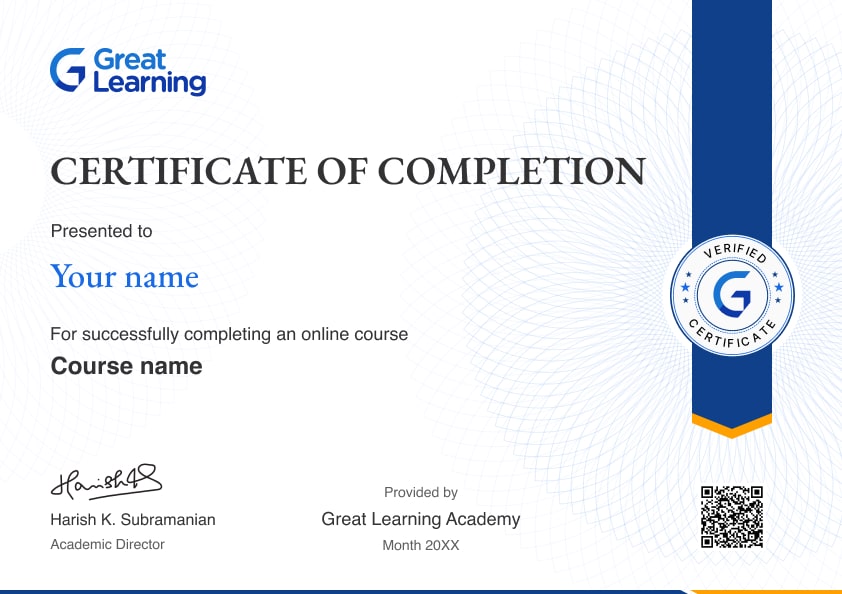
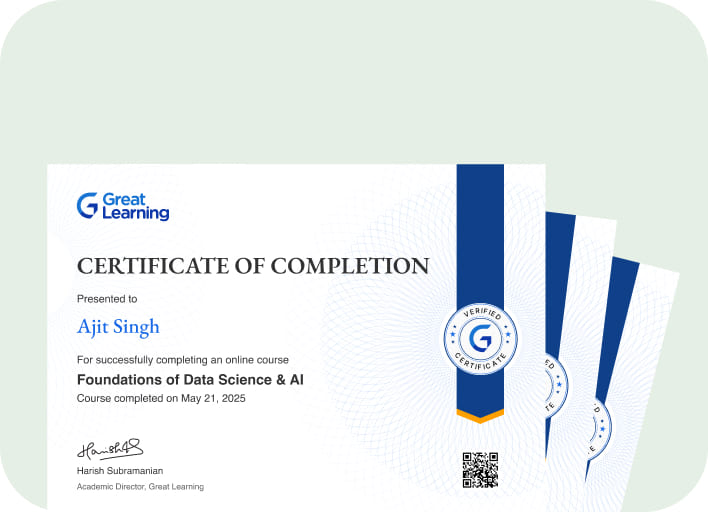
Yes, you will get a certificate of completion after completing all the modules and cracking the assessment.
What topics are covered in this Gen AI course free?
The course covers AI fundamentals, machine learning types, neural networks, deep learning concepts, large language models, generative AI principles, generative vs. discriminative models, ethics in AI, and a real-world healthcare case study. This makes it one of the more structured Gen AI free courses available for beginners.
How much does this Free Generative AI course Online cost?
It is an entirely free course from Great Learning Academy.
Do I learn about large language models in this course?
Yes,The course includes a dedicated section on large language models. You learn how LLMs evolved, the role of Transformers, and why these models are central to modern Generative AI systems.
Does this course explain how Generative AI is different from traditional AI?
Yes, The course clearly explains the difference between generative and discriminative models. You learn how Generative AI creates new content rather than only classifying or predicting outcomes.
Is there any limit on how many times I can take this free course?
No. There is no limit. Once you enrol in the free Generative AI course, you have lifetime access to it. So, you can log in anytime and learn it for free online.
Are ethical and responsible AI topics included in this Generative AI free course?
Yes, The course includes a module on ethics and responsible AI. It discusses fairness, bias, transparency, and accountable use of Generative AI systems.
Does this free Generative AI free online course include real-world examples?
Yes, The course uses real-world examples and a healthcare case study to show how Generative AI concepts apply in practical scenarios
Who should take this Generative AI Training free course?
This course is suitable for freshers, working professionals, managers, and career switchers who want a clear introduction to Generative AI. It works well for anyone exploring a generative AI free course before moving into advanced learning.
Is this Free Gen AI course self-paced?
Yes,The course is fully self-paced. You can start anytime, pause, and revisit lessons as needed, which makes it flexible for learners balancing work or studies.
Become a Skilled Professional with Pro Courses
Gain work-ready skills with guided projects, top faculty and AI tools, all at an affordable price.








.jpg)











.png)
.png)

.png)
.jpg)
.jpg)
.jpg)

.jpg)
.png)

.png)
.png)

.png)
.png)
.png)
.png)
.png)
.png)


.png)
.png)
.png)
.png)
.png)






.png)
.jpeg)
.jpg)

 (1).jpg)
.png)
.png)
.png)

.png)
.png)
.png)
.jpg)



.png)



 (1).png)

Recommended Free Generative AI courses
 FREE
FREE
.jpg) FREE
FREE
 FREE
FREE
 FREE
FREE

Similar courses you might like
FREE
 FREE
FREE
 FREE
FREE
.jpg) FREE
FREE

Related ChatGPT and Generative AI Courses

-

Johns Hopkins University
Certificate Program in AI Business Strategy10 weeks · Online
Know More
-
Walsh College
MS in Artificial Intelligence & Machine Learning2 Years · Online
Know More
-
MIT Professional Education
No Code and Agentic AI12 Weeks · Online · Weekend
Learn from MIT FacultyKnow More