
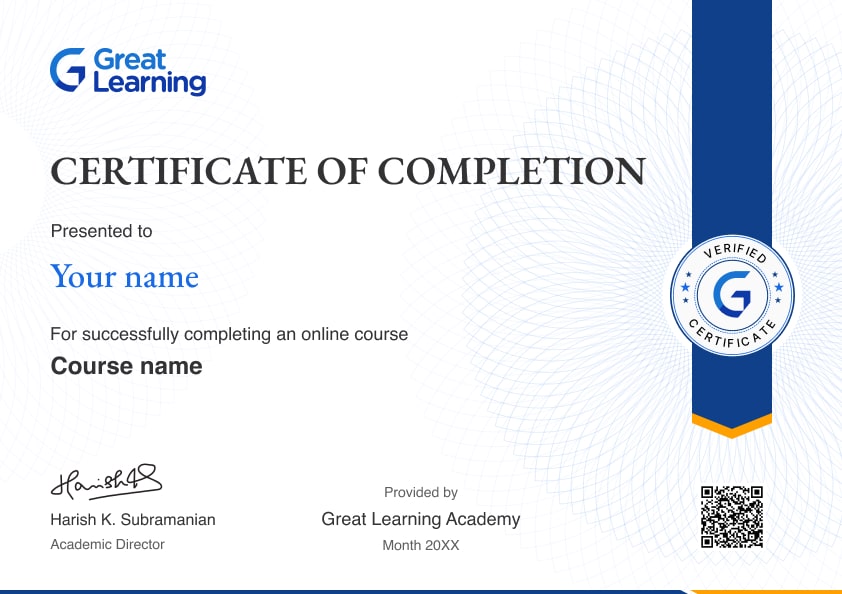
Earn a certificate & get recognized
Introduction to Graph Theory
 4.49
Beginner level
9.75 learning hrs
4.49
Beginner level
9.75 learning hrs
Enrol now for our free course covering graph basics, algorithms (Prims, Floyd-Warshall), and practical Python applications. Start your learning journey today!




About this course
Introduction to Graph Theory is a free course designed to provide you with fundamental knowledge and practical skills in graph theory. In the first part, we'll delve into the Basics of Graph Theory, exploring key concepts such as vertices, edges, and various types of graphs. The course then progresses to Graph-Based Algorithms, where you'll unravel the intricacies of essential algorithms like Prim's and Floyd Warshall, gaining insights into their applications, efficiency and implementation in Java.
The second part of the course focuses on implementing these algorithms in Python, ensuring you can seamlessly translate theoretical concepts into practical solutions. Join us in this engaging exploration of graph theory essentials, and enhance your problem-solving toolkit with hands-on experience in using graphs in Python.
Explore our Software Engineering courses for even more exciting opportunities. Start your journey to becoming a programming pro today!
Course outline
Basics of Graph Theory
This module introduces the foundational concepts of graph theory, covering vertices, edges, and key terminology in graph theory.
Graph Based Algorithms
In this module, we explore various graph-based algorithms, highlighting their applications and problem-solving capabilities.
Prims Algorithm
Delve into Prim's algorithm, a fundamental graph algorithm used to find minimum spanning trees in connected graphs.
Floyd-Warshall Algorithm
Explore the Floyd-Warshall algorithm, which provides efficient solutions for all-pairs shortest path problems in weighted graphs.
Graphs in Python
In this module, we learn how to implement and manipulate graphs using Python, enabling practical application of graph theory in python pragrams
Get access to the complete curriculum once you enroll in the course
 4.49
4.49






 India
India

 United Arab Emirates
Frequently Asked Questions
Will I receive a certificate upon completing this free course?
Is this course free?
What prerequisites are required to enrol in this Free Graph Theory course?
You do not need any prior knowledge to enrol in this Graph Theory course.
How long does it take to complete this Free Graph Theory course?
It is a 7.0 hour long course, but it is self-paced. Once you enrol, you can take your own time to complete the course.
Will I have lifetime access to the free course?
Yes, once you enrol in the course, you will have lifetime access to any of the Great Learning Academy’s free courses. You can log in and learn whenever you want to.
Will I get a certificate after completing this Free Graph Theory course?
Yes, you will get a certificate of completion after completing all the modules and cracking the assessment.
Is there any limit on how many times I can take this free course?
No. There is no limit. Once you enrol in the Free Graph Theory course, you have lifetime access to it. So, you can log in anytime and learn it for free online.
How much does this Graph Theory course cost?
It is an entirely free course from Great Learning Academy.
Become a Skilled Professional with Pro Courses
Gain work-ready skills with guided projects, top faculty and AI tools, all at an affordable price.
 PRO
PRO








.jpg)





.png)
.png)


.png)


.png)
.jpg)

.jpg)
.png)
.jpg)
.jpeg)








.png)
.png)
.png)
.png)
.png)
.jpg)
.jpg)
.png)


.png)
.png)





 (1).png)

.jpg)
.png)
.png)
.png)
.png)


.png)

 (1).jpg)

.png)
.png)
.png)
.png)

.png)
.png)

.png)





Recommended Free Software courses
 FREE
FREE
 FREE
FREE
 FREE
FREE


Similar courses you might like
FREE
 FREE
FREE
 FREE
FREE
 FREE
FREE

Relevant Career Paths >


Other IT & Software tutorials for you
Introduction to Graph Theory
Graph theory is a branch of mathematics that explores the relationships between entities and the patterns that emerge from these connections. It is a powerful tool used to model and analyze various real-world systems, ranging from social networks and transportation systems to biological networks and communication systems. The field of graph theory was pioneered by mathematicians such as Leonhard Euler in the 18th century and has since become a fundamental and interdisciplinary area of study.
At its core, a graph consists of a set of vertices (or nodes) and a set of edges that connect pairs of vertices. The vertices represent entities, while the edges represent relationships or connections between these entities. Graphs can be classified into different types based on their characteristics, such as directed graphs (digraphs) where edges have a direction, or weighted graphs where edges have associated weights or costs.
One of the fundamental concepts in graph theory is the "path." A path is a sequence of vertices where each adjacent pair is connected by an edge. The length of a path is the number of edges it contains. If a path forms a closed loop, it is called a "cycle." Graphs without cycles are termed acyclic, and they play a crucial role in various applications.
Graph theory provides a powerful framework for solving problems in diverse fields. In computer science, graphs are used to represent networks, databases, and relationships between data points. Search algorithms, such as depth-first search and breadth-first search, leverage graph theory to traverse and explore data structures efficiently. In social network analysis, vertices may represent individuals, and edges may represent relationships or interactions between them. Analyzing the structure of such graphs can reveal patterns of influence, connectivity, and information flow within a network.
Transportation systems, including road networks and airline routes, are often modeled using graphs. Graph algorithms can optimize routes, minimize travel times, and identify critical nodes or links in the network. Similarly, communication networks, such as the internet, can be represented as graphs, with routers or computers as vertices and communication links as edges.
The study of graph theory also extends to the realm of optimization. Problems such as the traveling salesman problem (finding the shortest possible route that visits a set of cities and returns to the starting city) and the maximum flow problem (determining the maximum amount of flow that can be sent through a network) are classic examples where graph algorithms are applied to find efficient solutions.
Graph theory has made significant contributions to the field of bioinformatics. Biological systems, including protein-protein interaction networks and metabolic pathways, can be modeled as graphs. Analyzing these graphs helps researchers understand the structure and function of biological systems, identify key components, and study the relationships between different biological entities.
In conclusion, graph theory is a versatile and essential tool with applications across various disciplines. Its ability to model and analyze relationships and connectivity makes it invaluable in solving real-world problems. As technology advances and new challenges emerge, the role of graph theory continues to expand, making it a cornerstone in both theoretical mathematics and applied sciences.